How many tigers in Ranthambore today, and how did the park get here? The full conservation story, from near-collapse to recovery.
It's one of the first questions anyone planning a trip here asks, and the honest answer takes a bit of context to be useful. How many tigers in Ranthambore right now depends on which census year you're looking at, because the park's tiger population hasn't moved in a straight line — it's been through a near-collapse, a recovery, another collapse, and a recovery that's still climbing today.
How Many Tigers in Ranthambore Today?
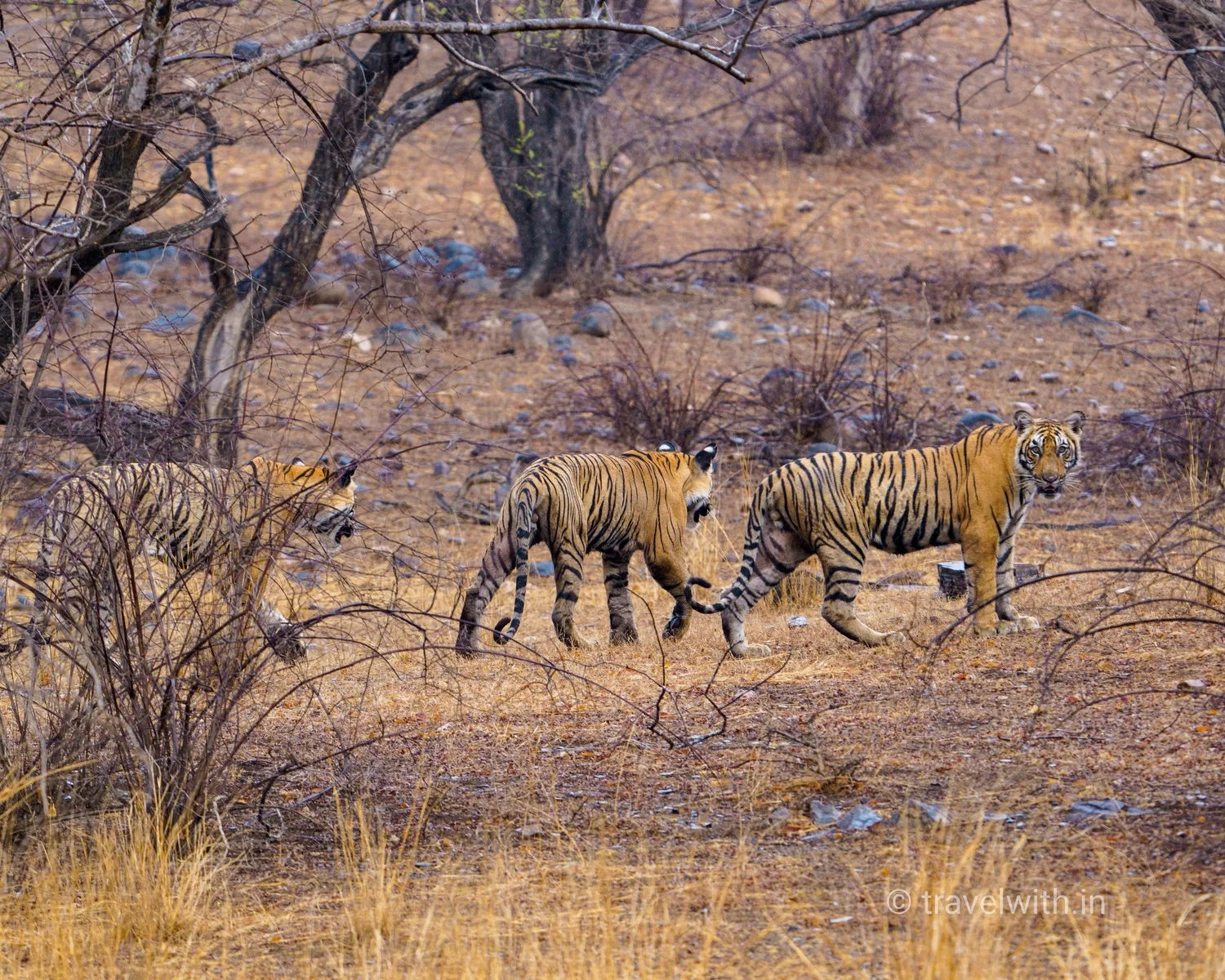
The National Tiger Conservation Authority's 2022 census put Ranthambore's population at 69 tigers, and more recent estimates from park authorities put the number above 80. The exact figure shifts slightly year to year — tigers move between the core reserve and adjoining sanctuaries, and counts are never perfectly precise for an animal this elusive — but the trend over the last two decades is unmistakably upward. Camera-trap surveys and pugmark tracking both feed into these estimates, along with direct sightings logged by forest staff and visitors throughout the year.
Before Project Tiger: A Population in Freefall
It wasn't always this way. Ranthambore was once the private hunting ground of the Maharajas of Jaipur and after independence, unregulated hunting and poaching continued to chip away at the population. By the early 1970s, a national tiger census put India's total wild tiger population at under 2,000, down from tens of thousands at the start of the century. Ranthambore's own numbers had fallen to somewhere around 14 tigers — a population small enough that local extinction was a real possibility, not a distant worry.
1973: Project Tiger Changes Everything
Prime Minister Indira Gandhi launched Project Tiger on the 1st of April, 1973, at Jim Corbett National Park, in direct response to that census. Ranthambore was folded into the programme as one of India's earliest tiger reserves, and over the following decade, sustained anti-poaching work and habitat protection brought the population back up to around 40 tigers by the 1980s — nearly triple the low point of a decade earlier. The park's boundaries also grew during this period, with the Kaila Devi and Sawai Mansingh sanctuaries added in the early 1980s, giving the tiger population significantly more protected ground to expand into.
The 2006 Setback and the Recovery That Followed
Recovery wasn't permanent. A fresh wave of poaching pressure through the 1990s and early 2000s pushed the population back down to roughly 16 tigers by 2006 — a setback that shook conservationists and forced a serious rethink of how the reserve was being protected. What followed was a genuine turnaround: tighter anti-poaching enforcement, better monitoring, and a tiger population with enough resilience left to rebuild. By 2014 the count had climbed back to around 64, and it has kept rising since — a recovery rate researchers attribute partly to Ranthambore's tigresses breeding more frequently than the species average once poaching pressure eased.
Machali: The Tigress Behind Much of Ranthambore's Bloodline
No account of Ranthambore's tigers is complete without T-16, better known by her nickname, Machali. She became one of the most photographed tigers in the world during her lifetime, and genetic studies since her death have found that a large share of Ranthambore's current tiger population descends from her. It's a remarkable legacy for a single animal, and also the root of a problem the park is now working through.
A Success Story With a Complication: Inbreeding
Because Ranthambore's tiger population is geographically isolated from other reserves, and because so many of today's tigers share ancestry through Machali, researchers have found the population is significantly more inbred than tiger populations in central India. A 2021 genetic study found Ranthambore's tigers were nearly twice as inbred as their central Indian counterparts, which can lower fertility and immune resilience over successive generations even as the raw headcount keeps rising. Conservationists have been pushing for a genetic rescue — introducing new bloodlines from other reserves — to keep the recovery from stalling out on itself. It's a reminder that a rising headcount and a genuinely healthy population aren't automatically the same thing.
Seeing Ranthambore's Tigers Today with 47 Safaris
Whatever the exact figure is this season, Ranthambore remains one of the most reliable places on earth to see a wild tiger, and that's the direct result of five decades of conservation work most visitors never think about while they're watching one cross the track ahead of their jeep. At 47 Safaris, our naturalists are fully aware of which zones have a high likelihood of future tiger movement and we use this intel to build your safari in your own private jeep, with permits handled before you arrive.
The question of how many tigers in Ranthambore will keep shifting as new census data comes in, but the story behind that number — a population pulled back from the edge, twice — is what makes seeing one here feel like more than just a photograph. If you'd like to see it for yourself, get in touch with 47 Safaris and we'll build the trip around you.
Travel with us
Every story here started as someone’s first enquiry.
Tell us what you want to see. We’ll build the journey around it — the right park, the right season, the right guide.
Plan your journey