You've probably seen the photos — a rhino standing chest-deep in golden grass, the Brahmaputra stretching flat to the horizon behind it. What most people don't have before they arrive is the practical Kaziranga National Park information that actually shapes the trip: where the park is, how it's organised, what's inside it, and when to go. So here it is, laid out plainly.
Where the Park Sits and How Big It Is
Kaziranga spans roughly 1,090 square kilometres across four districts of Assam — Golaghat, Nagaon, Sonitpur and Biswanath — along the southern bank of the Brahmaputra River. Most visitors base themselves near the Kohora range, on the park's southern boundary, since that's where the main entry gate (also called the Central zone) and most of the hotels sit. Jorhat is the nearest airport with direct flights from Delhi and Kolkata and is a two hour drive. Guwahati airport is a five hour drive with direct flights from multiple cities.
A Park With Several Names Before This One
There's a good story behind how this land came to be protected at all. In the early 1900s, Mary Curzon, wife of the then-Viceroy of India, travelled here specifically hoping to see the one-horned rhino — and couldn't find a single one. She pushed her husband to act, and the area was set aside as a reserve forest in 1905. It became a game sanctuary in 1916, a wildlife sanctuary in 1950, and finally a national park in 1974. In 1985, UNESCO listed it as a World Heritage Site.
The Four Ranges, and Why It Matters Which One You're In
Kaziranga isn't one continuous safari area — it's split into four separate ranges, and each behaves differently.
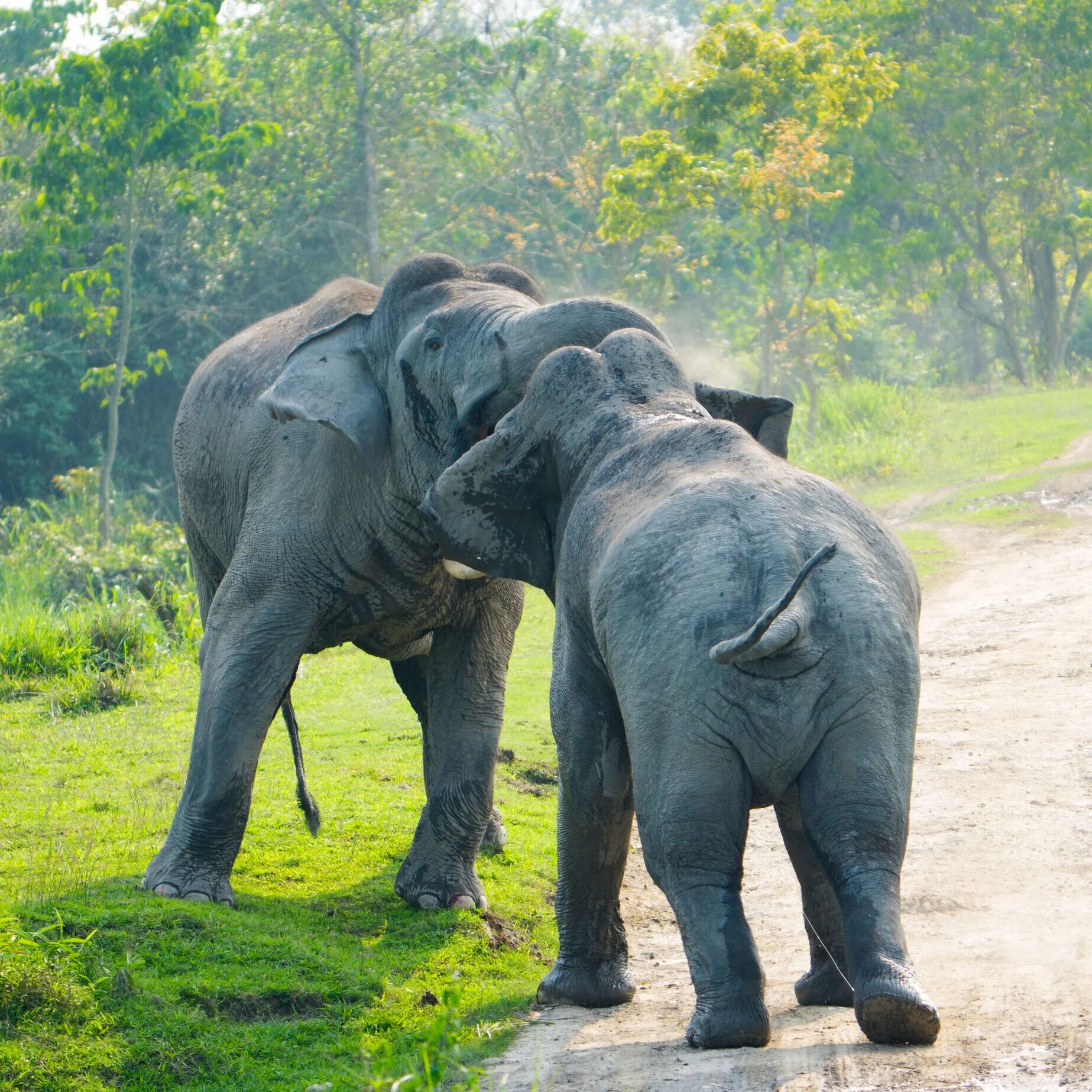
Kohora (Central Range): the most visited, closest to the main hotels, strong odds for the Big 5 (Bengal tiger, one-horned rhino, elephant, eastern swamp deer and wild water buffalo).
Bagori (Western Range): known for large rhino and wild water buffalo numbers and open grassland views.
Agaratoli (Eastern Range): quieter, closer to the river, good for birdlife, gangetic river dolphin and the Assam roofed turtle.
Burapahar (Western-most Range): furthest of all four zones, hillier terrain, less crowded, a different landscape entirely from the other three. Ideal to see Hoolock Gibbons, hornbills, otters and the Big 5.
What's Actually Living There
Kaziranga holds about two-thirds of the world's remaining one-horned rhinos — that single fact is why UNESCO listed it. But the park is also one of the only places in India where five large mammals share the same floodplain: rhino, Asian elephant, Bengal tiger, wild water buffalo and eastern swamp deer. Add the hoolock gibbon, India's only ape species, gangetic river dolphin and a bird list running into the hundreds, and there's a lot more here than the rhino photos suggest.
When the Park Is Actually Open
The park runs from roughly October to April and closes for the monsoon between May and September, when the Brahmaputra floods much of the grassland. November through January brings the coolest, clearest weather, February to April end gets warmer but brings the best sightings as that is when the grasslands are burnt in a controlled manner to make way for new grass, clear old vegetation and prevent overgrowth of tree saplings. The shorter grass and dry weather makes spotting wildlife easier since there's less cover.
Getting the Practical Side Right
This is the part most Kaziranga National Park information leaves out until it's too late to matter: permits, range allocation and hotel bookings all need to line up, and the ranges with the strongest Big 5 numbers fill up months ahead in peak season. Booking a jeep on arrival, hoping for the best range, is how a lot of first-timers end up disappointed.
This is exactly where 47 Safaris comes in. We handle the range selection, permits and hotel bookings before you land in Assam, and every safari runs in a private jeep with an English-speaking naturalist who knows this landscape well — not a shared vehicle grouped with strangers. If you'd rather have someone else sort the logistics while you focus on the trip itself, get in touch and we'll put together an itinerary around your dates.
Between the history, the ranges and the wildlife spread across them, there's more to plan around here than a single afternoon of research covers — which is exactly why most people booking their first trip end up asking someone who already knows the park to help.


